Stretch marks: why they appear and how to reduce their visibility
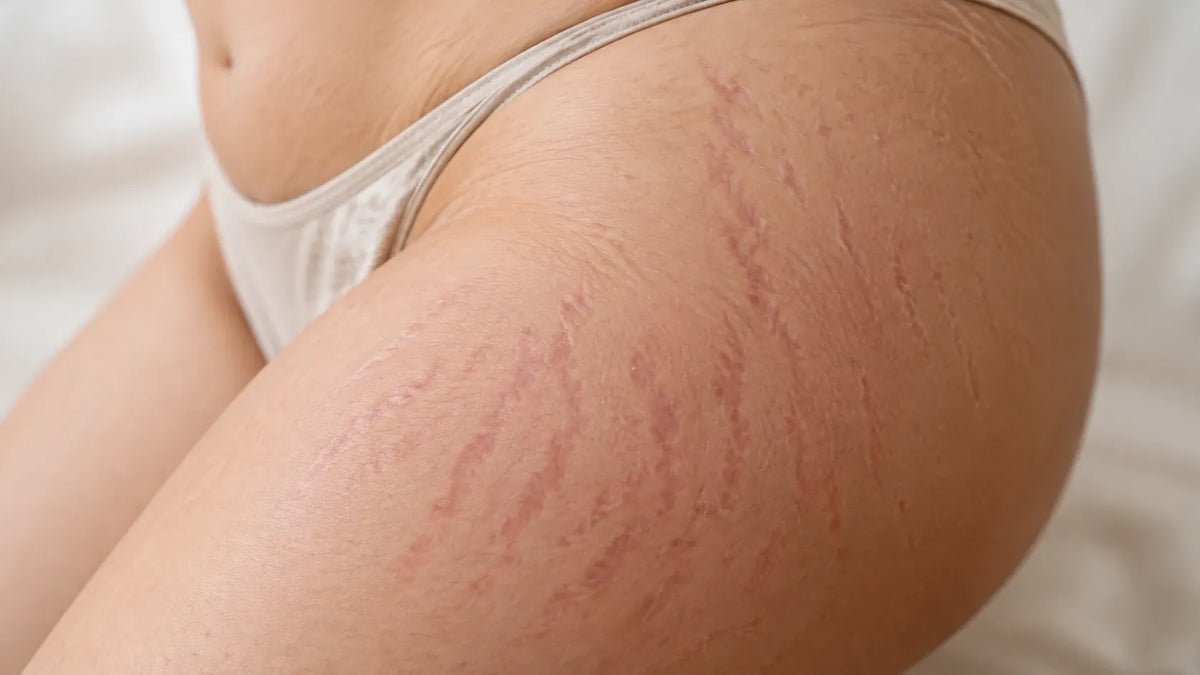
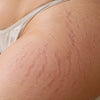
Stretch marks are one of the most common skin changes, and many people experience them at least once in their lives. They most often appear during pregnancy, in puberty, with rapid changes in body weight or with muscle growth. Although they are completely natural and harmless, many people would like to prevent them or at least make them less visible.
Can stretch marks be prevented or removed? Unfortunately, complete prevention or removal cannot be guaranteed. With the right care, however, we can improve the skin's hydration and condition, and some active ingredients also show promising results in preventing stretch marks and making them less pronounced.
One of the most interesting plant ingredients in this area is gotu kola (Centella asiatica), whose effect on collagen and elastin fibres has been studied in laboratory and clinical research. It is precisely because of these properties that we included it in the Beesmetic Stretch Mark Balm Stick, which combines active and nourishing ingredients for daily skin care.
But to understand what actually helps with stretch marks, we first need to know how they form and what happens in the deeper layers of the skin.
What are stretch marks and why do they appear?
Stretch marks, known medically as striae distensae, are changes in the connective tissue caused by rapid stretching or shrinking of the skin.
Our skin is made up of several layers. Particularly important for the formation of stretch marks is the dermis, the deeper layer of the skin that contains a supporting network of collagen and elastin fibres.
These two types of fibres have different but closely connected roles:
- Collagen gives the skin firmness, support and resistance to mechanical stress.
- Elastin allows the skin to stretch and then return towards its original shape.
When the body changes quickly, the skin has to adapt as well. If the stretching is too fast, or if the connective tissue is not resilient enough due to its individual properties, the collagen and elastin fibres can change and become damaged.
This is not simply a matter of the skin "tearing" on the surface. The changes happen deeper in the dermis, where the normal structure of the supporting fibres is disrupted.
The body starts to repair the affected tissue, but the new structure is often not quite the same as the original. The result is an area that may be thinner, less elastic and slightly sunken.
This is exactly what we see on the surface as a stretch mark.
Stretch marks are therefore scar-like changes in the deeper structure of the skin, not just surface lines or a change in pigmentation.
What happens to collagen and elastin?
Collagen, elastin and other components of connective tissue are produced by cells called fibroblasts.
We can think of them as the skin's little builders: they maintain its supporting network and help repair damaged tissue.
When a stretch mark forms, the activity of the fibroblasts and the arrangement of the fibres in the dermis change. Collagen fibres can lose their usual organisation, while the elastin network becomes damaged or altered.
This matters because for healthy skin function it is not only the amount of collagen that counts, but also how the fibres are arranged.
Disorganised fibres do not support the skin as effectively as a properly organised network.
Because of these changes, the area of a stretch mark may be less elastic, thinner and visibly different from the surrounding skin.

Why do some people get stretch marks and others don't?
Whether stretch marks form does not depend only on how fast the skin is stretched.
Genetics, hormonal changes and the individual properties of connective tissue also play an important role.
Stretch marks most often appear:
- In pregnancy: due to the growing belly and breasts and hormonal changes.
- In puberty: due to rapid physical growth.
- With changes in body weight: especially with rapid weight gain or weight loss.
- With intensive muscle growth: for example when training to build muscle mass.
They can also be caused by long-term use of certain corticosteroids or by certain hormonal or medical conditions.
Are stretch marks hereditary?
Yes, a hereditary predisposition plays an important role.
If your parents or other close relatives have pronounced stretch marks, you are more likely to get them too.
This does not mean, however, that you will definitely get stretch marks, or that you will definitely be able to prevent them with skin care.
Genetics is just one of the factors that influence how resilient and adaptable your connective tissue is.
Red and white stretch marks: what's the difference?
Stretch marks change in appearance over time. Telling fresh and older stretch marks apart is important, as they can respond differently to treatment.
Red stretch marks: the early stage
Fresh stretch marks are usually pink, red or purple. On darker skin they may also look brownish or darker in colour.
In the scientific literature they are called striae rubrae.
Their colour is linked to vascular and inflammatory changes in the skin. Fresh stretch marks can also be slightly itchy or sensitive.
At this stage the skin is still actively remodelling, which is why fresh stretch marks may respond better to certain types of care and dermatological treatment than older ones.
White stretch marks: the later stage
Over time, stretch marks usually fade and become lighter, whitish or silvery.
These stretch marks are called striae albae.
They are often slightly sunken, and their surface can feel different from the surrounding skin.
In older stretch marks the changes in the connective tissue are already more established, so they are generally harder to make less visible.
That is why, if you want to improve the appearance of stretch marks, it makes sense to start appropriate care as early as possible – with realistic expectations about the results.

How to prevent stretch marks?
Although there is no completely reliable prevention, we can look after our skin with regular care, proper moisturising and a thoughtful choice of active ingredients.
It is important to understand the difference between what the skin needs for good everyday care and which ingredients have actually been studied for preventing stretch marks.
1. Moisturise your skin regularly
One of the basic tasks of skin care is keeping the skin hydrated.
A well-formulated moisturising product helps reduce water loss, makes the skin feel softer and supports the skin barrier.
Different types of ingredients have different roles here.
- Humectants, such as glycerin and hyaluronic acid, bind water.
- Emollients, such as plant oils, butters and squalane, soften the skin and help limit moisture loss.
Combining them provides more complete care than using just one type of ingredient.
It should be stressed, however, that moisturising alone has no reliably proven effect in preventing stretch marks. It is above all an important part of everyday skin care, especially when the skin is dry, tight or itchy.
2. Use active ingredients to support your skin care
Besides basic moisturising ingredients, there are active ingredients whose effect on skin structure is also being studied at the cellular level.
One of them is gotu kola (Centella asiatica), which contains triterpenes linked to the processes of connective tissue formation and remodelling.
Research on certain gotu kola extracts shows interesting effects on fibroblasts, collagen and elastin.
This is also why gotu kola is one of the ingredients we chose for the Beesmetic Stretch Mark Balm Stick.
3. Gently massage your skin
When applying a balm or cream, you can gently spread it with circular movements.
Massage can feel pleasant, especially when your skin feels tight.
However, there is not enough good-quality evidence that massage alone reliably prevents stretch marks.
It is important not to rub the skin too hard or irritate it further.
4. Change your body weight gradually
Where possible, it makes sense to avoid sudden large fluctuations in body weight.
During pregnancy, however, deliberately limiting healthy weight gain in order to prevent stretch marks is not recommended.
The health of the mother and baby always matters more than the appearance of the skin.
Gotu kola (Centella asiatica): how does it work on the skin?
Gotu kola is a plant that has been used in traditional skin care for centuries.
In recent decades it has also attracted the interest of scientists, as it contains biologically active compounds, mainly triterpenes, such as:
- asiaticoside,
- asiatic acid,
- madecassic acid.
Researchers have studied their effect on fibroblast activity, collagen production and the repair of damaged connective tissue.
Why does this matter for stretch marks?
Because changes in collagen, elastin and other components of the dermis contribute significantly to their formation.

How does gotu kola affect fibroblasts?
Fibroblasts are the cells responsible for producing and maintaining the extracellular matrix – the supporting structure of the skin, which includes collagen and other components of connective tissue.
In 1999, Maquart and colleagues studied triterpenes from gotu kola in an animal wound-healing model.
They found that the compounds studied increased the accumulation of extracellular matrix components, including collagen and glycosaminoglycans.
Asiaticoside and asiatic acid were of particular interest.
These results suggest that certain components of gotu kola can influence the repair processes of connective tissue.
However, since the study was carried out in an animal wound-healing model, it does not in itself prove effectiveness against stretch marks in humans.
Effect on collagen organisation
An interesting study by Boira and colleagues from 2024 examined the effect of a specific gotu kola extract directly on cells and skin samples with stretch marks.
The researchers observed that the extract studied influenced the organisation of collagen fibres.
In stretch marks the fibres are often arranged differently than in healthy skin. After the samples were treated with the gotu kola extract, however, a more orderly organisation of the collagen network was observed.
This matters because the mechanical properties of the skin depend not only on the amount of collagen, but also on its structure and arrangement.
Effect on elastin
The same study also analysed elastin fibres.
Elastin is a protein that contributes to the skin's elasticity and its ability to return to its original shape after stretching.
After five days of treating isolated human skin samples with 0.5% of the gotu kola extract studied, the researchers measured 37% more elastin compared with untreated skin samples with stretch marks.
This result is encouraging, but it needs to be understood correctly.
The study was carried out on isolated skin samples under controlled laboratory conditions. It does not mean that applying any balm with gotu kola for five days will increase the amount of elastin in a person by the same percentage, or that stretch marks will already be visibly reduced.
Gotu kola and connective tissue remodelling
Boira and colleagues also studied the expression of genes linked to fibrosis and the breakdown of the extracellular matrix.
These included:
- CTGF and PTK2 (FAK) – markers linked to fibrosis and tissue remodelling.
- MMP1 and MMP7 – enzymes involved in breaking down components of the extracellular matrix.
After fibroblasts were treated with the gotu kola extract studied, reduced expression of these markers was observed.
Put simply: under laboratory conditions, the extract influenced processes linked to the breakdown and reorganisation of connective tissue.
This helps explain why gotu kola is of interest in stretch mark research.
Still, this is mainly a biological explanation of a possible mode of action, not a guarantee that every cosmetic product with gotu kola will effectively remove stretch marks.
What does research say about gotu kola for stretch marks?
Laboratory studies help us understand how ingredients work.
For the user, however, the more important question is whether these changes also show up in clinical studies in people.
Mallol study (1991): fewer stretch marks in pregnant women
80 pregnant women took part in this double-blind, placebo-controlled study.
The researchers compared a placebo with an active cream containing gotu kola extract, vitamin E and collagen and elastin hydrolysates.
The results showed that stretch marks developed in:
- 34% of women who used the active cream;
- 56% of women who used the placebo.
This represents an incidence 22 percentage points lower, or a relative reduction in the incidence of stretch marks of about 39% in the active cream group.
The researchers also observed less pronounced stretch marks in the active group.
The results were particularly interesting in women who had already had stretch marks in puberty, as they may be more prone to developing stretch marks in pregnancy too.
These are encouraging results, but two limitations need to be kept in mind:
First, the study was relatively small.
Second, the cream studied contained several active ingredients, so the effect cannot be attributed to gotu kola alone.
Togni study (2018): improvement in some skin properties after childbirth
In 2018, Togni and colleagues published a pilot study on the use of a gotu kola cream in women with stretch marks after childbirth.
54 women were included, divided into an active and a control group.
After four weeks of use, the active group showed statistically significant improvements in several measured parameters compared with the control group, including elasticity, skin thickness in the stretch mark area and local blood flow.
The results suggest that a particular formulation with gotu kola can improve some properties of skin with stretch marks.
However, this was a small pilot study, so the findings cannot be generalised to all products containing this plant.
Boira study (2024): improved collagen organisation and changes in elastin
The study by Boira and colleagues shed further light on what may happen at the level of skin tissue.
Under laboratory conditions, the researchers observed changes in the organisation of collagen fibres, an increased presence of elastin and a reduction in some markers linked to fibrosis and the breakdown of the extracellular matrix.
The results support the biological plausibility of certain gotu kola extracts acting on skin with stretch marks.
They do not prove, however, that every cosmetic product with this ingredient is equally effective.
Sanna study (2024): less pronounced stretch marks after childbirth
In the study by Sanna and colleagues, a gotu kola preparation was tested in women with stretch marks after childbirth.
The study included 20 participants.
After using the preparation, less pronounced stretch marks were observed more often in the active group than in the control group.
As this was a small, quasi-experimental study, its results mainly provide an additional basis for further research.
What does a broader review of the evidence say?
Individual studies can show promising effects, but it is important to look at the bigger picture too.
A Cochrane review of six studies involving a total of 800 women found no sufficiently convincing evidence that topical cosmetic preparations as a group reliably prevent stretch marks in pregnancy.
This does not rule out the possibility that some ingredients or formulations are beneficial.
It does mean, however, that we do not yet have enough high-quality, large-scale evidence to call any balm a reliable solution for preventing stretch marks.
How to reduce the appearance of existing stretch marks?
With stretch marks that have already formed, it is important to distinguish between improving their appearance and removing them completely.
Stretch marks are changes in the deeper connective tissue, so ordinary cosmetic care generally cannot remove them completely.
We can, however, take care of the skin's hydration, softness and overall condition, while certain active ingredients and dermatological procedures can help make them less noticeable.
What helps with red stretch marks?
Red stretch marks are newer changes in which the tissue is still actively remodelling.
Research shows that fresh stretch marks may respond better to certain types of treatment.
The active ingredients studied include hyaluronic acid, tretinoin and certain formulations with gotu kola.
Tretinoin is a medicinal active ingredient from the retinoid group. It is not suitable for use during pregnancy, so its use should be discussed with a doctor.
For cosmetic care, it makes sense to choose a product that combines moisturising and nourishing ingredients and is suitable for regular use.
What helps with white stretch marks?
White stretch marks are older changes in which the structure of the connective tissue is more established.
Their appearance is usually harder to improve than that of fresh stretch marks.
Creams and balms can make the skin feel softer and more cared for, but it has not been proven that they can completely remove old stretch marks.
For a more marked improvement in texture, dermatological procedures such as laser therapy, radiofrequency and certain microneedling procedures are used.
It is best to discuss the choice of a suitable procedure and the expected results with a dermatologist.
Stretch marks in pregnancy: when to start caring for your skin?
Pregnancy is a time when the skin adapts quickly to a changing body.
The growing belly and breasts, together with hormonal changes, can increase the likelihood of stretch marks.
If you want to establish a regular skin care routine, there is no need to wait for the first stretch marks to appear.
You can start caring for your skin in early pregnancy and continue during periods when your skin feels tighter or drier.
You can pay particular attention to the:
- belly,
- hips,
- thighs,
- breasts,
- buttocks.
When choosing a cosmetic product during pregnancy, always consider its composition, instructions and assessment of suitability for use during this period.
If stretch marks appear despite regular care, it does not mean you did something wrong. Factors such as genetics and hormonal balance also strongly influence whether they form.
Oil or balm for stretch marks: which to choose?
Natural oils are very popular for skin care during pregnancy and other periods of physical change.
Plant oils can soften the skin effectively and help limit moisture loss.
However, oils cannot be described as effective prevention against stretch marks simply because of their natural composition.
For example, research has not found convincing evidence that cocoa butter or olive oil on their own reliably prevent stretch marks.
When choosing a product, it is therefore better to look at its full formulation rather than just what it is called – an oil, a cream or a balm.
Well-designed care can combine:
- Humectants, which bind water in the skin.
- Emollients, which soften the skin and help limit moisture loss.
- Active ingredients, whose effects on various processes in the skin have been scientifically studied.
It is also important that the texture of the product feels pleasant and that you can easily use it every day.
Beesmetic Stretch Mark Balm Stick: thoughtful skin care
When developing the Beesmetic Stretch Mark Balm Stick, we wanted to create a product that combines everyday skin care with a thoughtful selection of active ingredients.
Its key ingredients include:
- Gotu kola (Centella asiatica) – a plant whose specific extracts are the subject of research on collagen, elastin and connective tissue remodelling.
- Niacinamide – a form of vitamin B3, popular for its role in supporting the skin barrier and improving the overall appearance of the skin.
- Glycerin – an effective humectant that binds water and helps keep the skin hydrated.
- Cocoa and shea butter – nourishing emollients that soften the skin and help reduce moisture loss.
- Squalane – a light emollient that makes the skin feel softer and supports its protective barrier.
The formulation also contains bakuchiol, which is being studied for its effect on the appearance and texture of the skin.
What makes the balm special is its practical stick format, which allows direct application without greasy hands. This makes it easy to include in your everyday skin care routine.
Frequently asked questions about stretch marks
Can stretch marks be removed completely?
Stretch marks generally do not disappear completely, as they are linked to changes in the deeper structure of the skin. They often fade over time, and certain dermatological procedures can make them less visible.
Can stretch marks in pregnancy be prevented?
There is no completely reliable way to prevent stretch marks. Some formulations with gotu kola and other active ingredients have shown promising results, but the broader scientific evidence does not yet allow any guarantee that a particular cream will prevent stretch marks.
Why are some stretch marks red and others white?
Red or purple stretch marks are usually newer and linked to active changes in the tissue. Over time they fade and become lighter, whitish or silvery.
Can white stretch marks regain their colour?
Older white stretch marks usually remain lighter than the surrounding skin. Their visibility can change, but there is no reliable cosmetic method that can give them exactly the same structure and colour as the surrounding skin.
How long does it take for stretch marks to fade?
Stretch marks usually fade gradually over several months, and in some people their appearance keeps changing for several years. How fast this happens depends on many individual factors.
Can gotu kola help with stretch marks?
In laboratory studies, certain gotu kola extracts have shown effects on collagen, elastin and skin remodelling processes. Some smaller clinical studies have also shown encouraging results regarding the occurrence and appearance of stretch marks. However, it has not been proven that every product with gotu kola is equally effective.
Is a cream or an oil better for stretch marks?
The composition of a product matters more than its form. Plant oils can soften the skin, while well-formulated creams and balms can combine humectants, emollients and additional active ingredients.
Can men get stretch marks too?
Yes. Stretch marks are also common in men, especially during puberty, with rapid body growth, muscle gain or changes in body weight.
When should you see a doctor about stretch marks?
If stretch marks appear very suddenly, are unusually wide or pronounced, or are accompanied by other unexplained physical symptoms, it is a good idea to see a doctor. In some cases they may be linked to hormonal disorders or the use of certain medicines.
In conclusion: stretch marks are natural, and skin care can be thoughtful
Stretch marks are a common part of bodily changes and are not a sign that anything is wrong with your skin.
Whether they form depends on an interplay of genetics, hormones and mechanical changes in the skin, so they cannot always be prevented.
Even so, thoughtful everyday care has its value.
With suitable moisturising ingredients we can keep the skin soft and cared for, and with active ingredients such as gotu kola we also include substances whose effects on skin structure are being actively researched.
What matters most is to have realistic expectations, choose a suitable formulation and use it consistently.
About the author
Rebeka Udvanc, MSc in Biotechnology and founder of Beesmetic
Rebeka Udvanc holds a master's degree in biotechnology and is the founder of the Slovenian cosmetics brand Beesmetic, where she combines her interest in science, cosmetic formulation and natural ingredients.
When developing products, she pays particular attention to the choice of ingredients and to understanding how they work on the skin.
Her guiding principle is to connect scientific findings with thoughtful everyday care.
This article is for informational purposes only. It includes a presentation of a cosmetic product by the Beesmetic brand, which was founded by the author.
Scientific sources and literature
- Mallol J. et al. (1991). Prophylaxis of Striae gravidarum with a topical formulation. A double blind trial. International Journal of Cosmetic Science, 13(1), 51–57.
https://doi.org/10.1111/j.1467-2494.1991.tb00547.x - Boira C. et al. (2024). The Natural Centella asiatica Extract Acts as a Stretch Mark Eraser: A Biological Evaluation. Cosmetics, 11(1), 15.
https://doi.org/10.3390/cosmetics11010015 - Maquart F.-X. et al. (1999). Triterpenes from Centella asiatica stimulate extracellular matrix accumulation in rat experimental wounds. European Journal of Dermatology, 9(4), 289–296.
https://pubmed.ncbi.nlm.nih.gov/10356407/ - Togni S. et al. (2018). Postpartum stretch marks treated with Centella asiatica cream: report of efficacy from a pilot registry study. Esperienze Dermatologiche, 20, 23–26.
https://doi.org/10.23736/S1128-9155.18.00460-0 - Sanna A. et al. (2024). Effect of Centella Asiatica Powder (Gotu Kola) Against Stretch Marks in Postpartum Mothers. KESANS: International Journal of Health and Science, 3(4), 334–342.
https://doi.org/10.54543/kesans.v3i4.247 - Brennan M., Young G., Devane D. (2012). Topical preparations for preventing stretch marks in pregnancy. Cochrane Database of Systematic Reviews, Issue 11.
https://doi.org/10.1002/14651858.CD000066.pub2 - American Academy of Dermatology. Stretch marks: Why they appear and how to get rid of them.
https://www.aad.org/public/cosmetic/scars-stretch-marks/stretch-marks-why-appear
-
Posted in
Gotu kola, Strije, Strije v nosečnosti